
Liquid-Cooled GPU Workstations: Quiet, Multi-GPU, LLM-Ready
Complete water-cooled GPU workstation solutions, from a single RTX 5090 / 4090 up to 4× RTX PRO 6000, with liquid-cooled A800 and L40S options. A fully sealed liquid loop holds full-load noise near 40 dB, so four 500W-class cards can sit under an office desk — ideal for laboratories, design studios and R&D rooms where air-cooled noise is unacceptable.
See liquid-cooled configurations Request a quotationThree air-cooling dead ends that liquid cooling solves
Many assume liquid cooling is about overclocking or looks. In commercial use it solves three very practical problems:
Noise: from server-room to office level
One RTX 5090 draws 575W at full load; four means 2,300W of heat. Air cooling must push high-speed fans, and full-load noise often exceeds 60 dB — like running a vacuum cleaner continuously. Liquid cooling carries heat straight to the radiator so fans can spin slowly, typically holding full-load noise around 40 dB: a level you can work next to.
Multi-GPU: four cards without a heat island
With four cards mounted side by side, the middle two breathe the exhaust of the ones before them; temperatures stack until the cards throttle and the nominal compute is never reached. Liquid cooling gives each card its own loop at a common inlet temperature, so spread across four cards stays within a few degrees and long training runs do not downclock.
Lifespan and stability: GPUs dislike heat
Running above 80°C for long periods accelerates ageing of memory and VRM components; a card dropping out halfway through a training run is the most expensive kind of failure. Liquid cooling holds full-load temperatures in the 60–70°C band, with more predictable failure rates and service life.
Liquid-cooled GPU workstation product line
| Tier | GPU options | Total memory | Best for |
|---|---|---|---|
| Single-GPU liquid workstation Desktop class, most popular | RTX 5090 32G liquid RTX 4090 24G liquid | 24–32GB | Individual developers, algorithm engineers debugging locally, 3D rendering, 8K video editing |
| Dual-GPU liquid workstation | 2 × RTX 5090 / 4090 2 × RTX PRO 6000 | 48–192GB | Mid-size model fine-tuning, parallel multi-task inference, multi-track post-production rendering |
| 4-GPU liquid workstation Most searched, the value sweet spot | 4 × RTX 5090 32G 4 × RTX PRO 6000 96G 4 × L40S 48G | 128–384GB | 70B-class local inference, LoRA fine-tuning, scientific simulation, shared multi-user compute |
| Silent liquid workstation | One or two cards + large radiator + low-speed fans | Depends on card | Offices, meeting rooms, hospital imaging departments, libraries, recording studios — noise-sensitive spaces |
These are the common tiers; actual configurations can be tailored to memory capacity, chassis size, noise requirements and budget.
Why is everyone searching for “4-GPU”?
Four cards is the value inflection point for GPU workstations, and the practical threshold for local LLM deployment:
- Memory spans exactly the mainstream models: 4 × 32GB = 128GB, comfortable for 4-bit quantized 70B-class models; 4 × 96GB = 384GB opens up larger parameter counts or full-precision scenarios
- Far cheaper than an 8-GPU server: an 8-GPU system requires a rack server plus a server-room environment, doubling the investment; a 4-GPU workstation goes straight into an office
- Power is achievable: a 4-GPU system typically draws 3–4 kW, which a dedicated office circuit can supply — no server-room-grade electrical work needed
- Enough is enough: most enterprises need local inference plus fine-tuning, not pre-training from scratch — four cards are sufficient
When you need more scale, move up to a rack GPU server; the two combine into “workstation at the office, server in the server room”.
Local LLM deployment: why customers increasingly keep it in-house
In 2026 the main driver for buying a GPU workstation has shifted from “faster rendering” to “data cannot leave the building”:
Data compliance
Medical records, legal files, financial data and R&D drawings all require a compliance review before going through a public cloud API. Local deployment keeps data on the intranet and removes that review entirely.
Long-term cost
Under heavy use, per-token API billing is a linear cost curve, while local hardware is a one-off investment. Beyond a certain daily volume, payback typically lands within a year.
Control
Model version, inference parameters and response latency stay in your hands — provider policy changes or rate limits cannot disrupt your business.
Our liquid workstations ship with drivers, CUDA and inference frameworks (Ollama / vLLM / LM Studio and others) pre-installed, and we help with model quantization and memory planning — you are not handed an empty box with hardware inside.
Card selection: 5090 or PRO 6000?
| Item | RTX 5090 (32G GDDR7) | RTX PRO 6000 (96G GDDR7 ECC) |
|---|---|---|
| Memory | 32GB | 96GB with ECC |
| Card power | 575W | 600W (workstation) / 300W (Max-Q) |
| Positioning | Consumer flagship, value route | Professional card, long-run stability and ISV certification |
| Strength | Single-machine development, rendering, mid-size inference | LLM inference, scientific computing, multi-GPU parallelism, 24/7 workloads |
| Cost | Low | High — several times a consumer card |
One-line advice: budget-sensitive and running models under 32B — choose the 5090; running 70B and above, needing ECC and sustained long-run stability — choose the PRO 6000.
Running DeepSeek V4 on this machine: how does it perform?
This is the question customers ask most. DeepSeek V4 is open-sourced (MIT licence, weights usable commercially) in two official tiers: V4-Flash (285B total / 13B active, about 160GB of weights) and V4-Pro (1.6T total / 49B active, about 865GB), both supporting 1M context. Whether it runs — and how fast — depends first on whether memory holds it, then on bandwidth:
| Liquid workstation | Total memory | DeepSeek V4-Flash (full) | DeepSeek V4-Pro (full) | Flash speed (single stream, est.) |
|---|---|---|---|---|
| 4× PRO 6000 Max-Q liquid | 384GB | Comfortable deployment, ample KV cache, 1M context at ease | Does not fit (about 480GB short) | ~150–250 token/s |
| 8× PRO 6000 Max-Q liquid | 768GB | Comfortable, multiple concurrent streams | Does not fit (about 100GB short) | Similar per stream, double the aggregate throughput |
| 4× RTX 5090 liquid | 128GB | Full version does not fit; runs official distilled builds and 70B-class open models | Does not fit | — (about 200+ token/s on distilled / smaller models) |
Note: the figures above are empirical estimates derived from weight-file size and memory bandwidth, not benchmark commitments. Real throughput depends on the quantization scheme, inference framework (vLLM / SGLang / TensorRT-LLM), context length and concurrency. DeepSeek V4 weights are FP4 in the expert layers and FP8 elsewhere, so further bit-reduction yields little. KV cache needs extra memory — reserve 20%–30% headroom for long-context work. We can produce a measured report for your own model and concurrency profile before you order. The ranges are consistent with public community benchmarks: 4× RTX PRO 6000 running V4-Flash on vLLM + FP4 measured roughly 133–235 token/s single-stream (235 at short context, 133 at 256K); 2 cards / 192GB measured about 106 token/s single-stream.
White-label liquid systems: real photos
Actual photos of white-label custom systems (unbranded, rebranded or ODM): from desktop one- and two-card water-cooled workstations to tower four-card liquid systems. No brand markings, project branding available, suited to delivery as deep-learning workstation systems, AI compute appliances and LLM appliances.
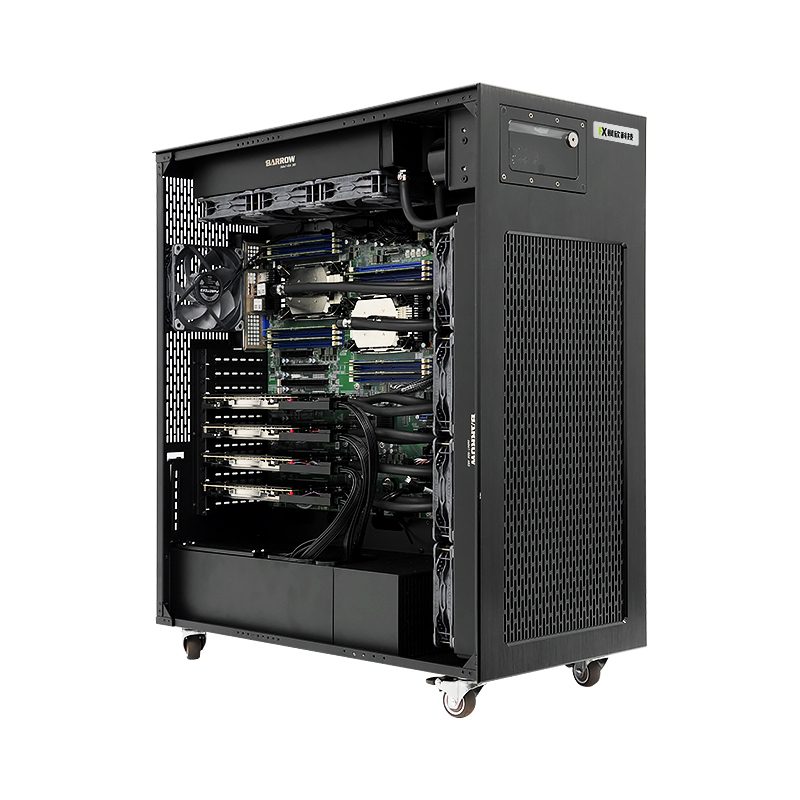
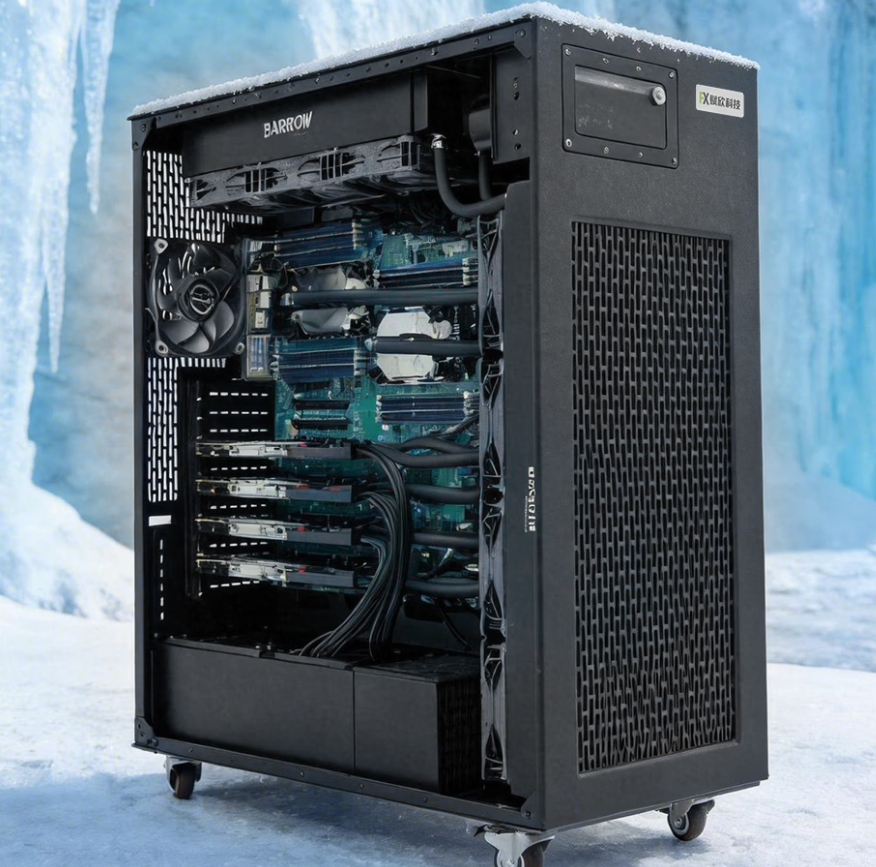
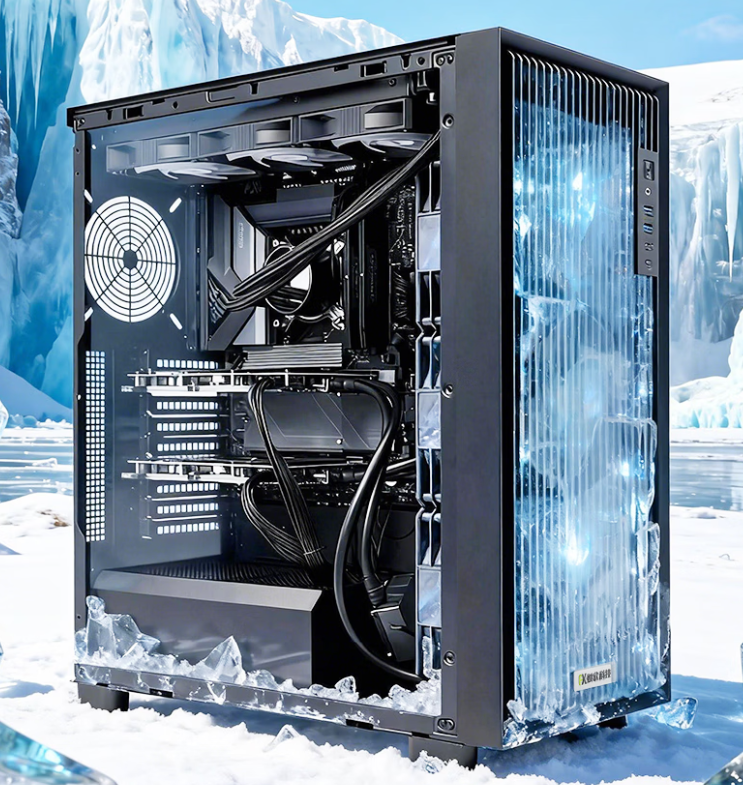
White-label GPU workstation customisation: systems, branding and ODM
Many customers search for “white-label workstation”, “unbranded GPU system” or “custom water-cooled workstation” and are after the same thing: strip the brand premium and specify everything to requirement. Our white-label liquid GPU workstations span one, two, four and eight cards; CPU platform (Intel / AMD), card model (RTX 5090, 4090, PRO 6000, L40S, A800), chassis and radiator, and power are all tailored to the scenario. We can also deliver a complete “local LLM deployment appliance” with drivers, CUDA and inference frameworks pre-installed and ready at power-on.
- Optional all-NVMe storage: datasets no longer bottleneck on the disk — NVMe SSDs deliver hundreds of thousands to a million IOPS randomly, multiplying dataset load throughput
- Silence tailored to the room: liquid systems reach office-level noise; air-cooled builds get ducting and airflow matched to the server-room conditions
- Systems, not parts: 48-hour full-load burn-in, pressure testing of the liquid loop, on-site deployment and a measured report — brand-grade delivery standards with a configuration entirely your own
Delivery and service
- Requirements: model size, concurrency, noise limits, site conditions
- Design: card model, card count, chassis and radiator, power plan
- Assembly: liquid-loop pressure test, 48-hour full-load burn-in
- Environment: drivers, CUDA, inference framework, model quantization
- On-site deployment: installation, noise and temperature measurement, delivery report
- After-sales: system warranty, on-site or return-to-base repair, standby unit support
FAQ
Can a liquid loop leak and fry the machine?
Industrial-grade integrated liquid loops are fully sealed and pressure-tested plus 48-hour burn-in before shipping; leakage in normal use is extremely unlikely. We commit in the contract that hardware damage caused by a defect in the liquid loop is covered by us. This is a main reason to buy an integrated system rather than building it yourself.
Does liquid cooling need maintenance? How often is coolant changed?
Sealed integrated loops are maintenance-free with no top-ups. We recommend an inspection every 2–3 years (dust removal from fans, pump speed check, temperature curve review); we offer an annual inspection service.
How quiet is the silent build? Can it go in a normal office?
A single-card silent build is near-inaudible at light load (around 30 dB) and typically around 40 dB at full load — the background level of a quiet office, fine beside a desk. A 4-card build is a little louder at full load; we recommend a separate room or local acoustic treatment, and will tell you in advance based on measured data.
What electrical supply does a 4-GPU workstation need?
A 4-GPU system typically draws 3–4 kW at full load, requiring a dedicated circuit (220V / 32A or above) and adequate air-conditioning capacity. Before ordering we issue a site-condition checklist and can help coordinate an electrical contractor.
Can I buy the liquid system only and supply my own cards?
Yes, but card model and water-block compatibility must be confirmed first. With customer-supplied cards, we warrant the liquid-cooling portion; the cards carry their manufacturer warranty.
Do you offer liquid-cooled A800 / L40S?
Yes. Both A800 80G and L40S 48G can be liquid-cooled, most often for research institutes, university labs and government/enterprise projects. These cards involve procurement qualification and compliance requirements — please discuss deliverability with us separately.
One-to-one consultant
Direct line to the right product owner — phone or email on workdays 9:00–18:00, same-day replies
Want a liquid-cooled GPU workstation configuration?
Tell us model size, card count and where the machine will sit; we will return configuration, pricing and measured noise data.
Call Mr. Shi +86 135-6435-3924 Leave a message onlineRelated products: Rack GPU server | GPU card line-up | Server rental
Frequently Asked Questions
What are the benefits of a liquid-cooled GPU workstation?
Liquid cooling keeps multi-GPU workstations quiet and stable under sustained load, prevents thermal throttling, and extends component life compared with air cooling.
Can the workstation be customized?
Yes. CPU, GPU, memory, storage and cooling layout can be configured for your workload, including LLM fine-tuning, CAE simulation and film rendering.
Who should use a liquid-cooled workstation instead of a rack server?
Labs, studios and offices without server-room space choose workstations for desk-side deployment with near-server performance.
Do liquid-cooled workstations come with a warranty?
Yes. All units are burn-in tested before delivery and include warranty coverage plus remote technical support.